How to play - Quick guide
The game
Introduction
Fish n’ Ships is a card game developed to communicate ecological knowledge on marine ecosystems and on the sustainable management of its resources used by fishing. The game is based on key concepts such as trophic levels, ecological pyramid, importance of fisheries and its correct management. Try fishing in a sustainable way in your sea to obtain more points than the other players
THE CARDS
The cards represent 36 different species of the Adriatic Sea divided into 4 groups based on their position in the food chain (Trophic level; note 1): primary producers or autotrophs (green cards), primary consumers (yellow cards), secondary consumers (orange cards), tertiary consumers (red cards).
In the first phase of the game the players have to develop their own marine ecosystem, in which there must be organisms from all trophic levels.
A player with a healthy sea (i.e. with at least one red card) can start the second phase of the game: use the fishing cards to fish in the player’s own sea.
Every player starts with eight fishing cards, each one corresponding to a fishing technique commonly used in the Adriatic Sea, with their target species and secondary effects on other species.
There are other cards related to human activities or natural events that may affect the game by adding uncertainty and unpredictability, but also incrementing interactions among players. Some of these cards have positive effects on marine ecosystem and are called “Bonus” (Marine protected areas, Fishing innovations) and some others have negative effects and are called “Malus”(climate change, eutrophycation, illegal fishing, alien species).
SCORE
Scores are assigned based on the healthy status of the player’s sea and on how s/he fished in a sustainable way. The total score is thus obtained by giving one point for each species present in the sea at the end of the game, plus the points associated to each fished species (top right corner). The fishing activities applied have also a score based on the socio-cultural value of the activity (top right corner of the card). Extra score is obtained for some achievement earned during the game
Key concepts
Some features of the game enable understanding key concepts of the marine ecosystem and its sustainable use.
THE TROPHIC LEVEL
The color of cards (green, yellow, orange and red) is linked to the trophic level of the species. The trophic level is the number of passages that the energy makes in the food chain. Using the primary producers as the base trophic level equal to 1, then the herbivores (primary consumers) have trophic level 2, the carnivores (secondary consumers) have trophic level 3, etc. Some marine species such as big sharks and tunas can reach up to trophic level 5 and are called top-predators (or apex predators).
THE ECOLOGICAL PYRAMID
An ecological pyramid is a representation of the biomass produced at each trophic level in the ecosystem and it decreases naturally when moving to higher trophic levels.
The pyramid has the primary producers at the bottom (for example marine plants), on top of which are the next trophic level (herbivores), followed by the secondary carnivorous (predators of herbivores). The highest level is the top of the food chain.
MALUS EVENTS
Malus cards represent bad events or habits that cause damage to the ecosystem, like climate change or illegal fishing. All these events impact directly or indirectly on all marine organisms
BONUS EVENTS
Bonus cards represent good events or habits for the ecosystem, like the establishment of Marine Protected Areas or innovation in fishing techniques
SECONDARY EFFECTS OF FISHING
Some fishing equipment although directed toward target species can produce accidental damage to the marine ecosystem and other species. The secondary effects of fishing could be:
- Damage to habitats, as those produced for example by fishing equipment that impact the sea bottom.
- Direct damage on non target species that can be accidentally caught (by-catch) representing the pool of unwanted creatures that are discarded during fishing operations (discard). Selective fishing equipment are those that catch mainly target species, avoiding harmful wastes represented by the discard.
FISHING IS IMPORTANT
To win the game, a player must fish in the most sustainable way, as fishermen in real life.
TUTORIAL – HOW TO PLAY
Login and begin a new game or join a current game. Game can be played from 1 to 4 players
AIM OF THE GAME
fish in a sustainable way in your sea in order to obtain more points than other players.
PLAYING
Every player starts having eight fishing cards, each one corresponding to a fishing technique commonly used in the Adriatic Sea.
Five cards are in the middle of the table. In the first phase of the game the players have to “build” their marine ecosystem, which must include organisms from all trophic levels. At every turn, each player can pick up one card among the five uncovered in the middle of the table, add the chosen card to his/her ecosystem.
The number of producers (green species cards) that can be placed in the marine ecosystem of each player is unlimited, while the following trophic levels (yellow, orange and red species cards) can have at maximum one card less than the trophic level below.
During the game, if a card is no more sustained by the level below, it will be lost by the player.
A player with a healthy sea (i.e. with at least one tertiary consumer- red card) can start the second phase of the game: fishing in their own ecosystem. The player can choose a fishing technique and cannot pick any card from uncovered cards in the middle of the table during the same turn.
On the fishing cards are indicated the target species (green circles) that can be caught with that specific fishing technique. On each species card are indicated the techniques that can be used for fishing that species.
A fishing technique is applied during the turn by removing one species that can be fished from the player’s own sea. If the fishing technique admits damages on species (indicated in red circles) the player will also lose one damaged species from his/her own sea. When fishing, the players must be careful on possible negative effects of their actions.
Each fishing technique can be used only once: the used fishing card is collected by each player together with the fished species to be counted at the end of the game in the final score.
The game ends when a player applies five of the eight fishing techniques.
Malus and bonus cards are events that have positive or negative impacts on marine ecosystems. When a card is turned over from the deck, all players are immediately affected by.DEADLOCKS
In some cases, a player could face the situation in which no action is possible. In this situation, player can shuffle the play deck and other five cards are uncovered in the middle of the table, loosing one point.
SCORING
At the end of the game, each player counts theirown score in this way:
Each species card belonging to the player’s ecosystem will count 1 point.
Species cards that have been fished have the score indicated on the top right of the card as well as fishing cards that have been used. Extra score is obtained for the achievements earned during the game. Total score is the sum of all these points.
The player with the highest score wins.
Video tutorial
The video loads from YouTube only when you start it: until then no data is sent to YouTube.
The cards in the deck
The species of the Adriatic Sea, the malus and the bonus cards. Tap a card to read it.
1 Producers
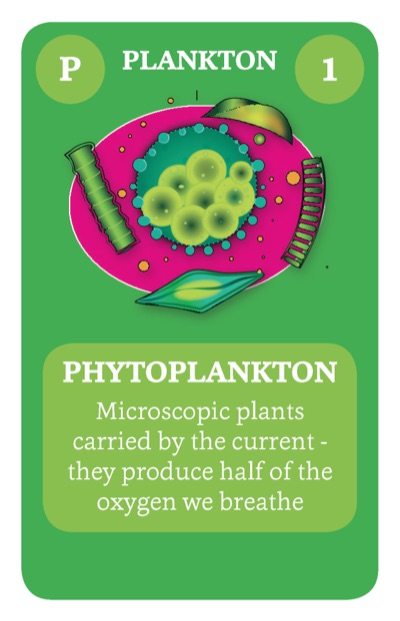 Phytoplankton
26 copies
Plankton · Microscopic plants carried by the current - they produce half of the oxygen we breathe
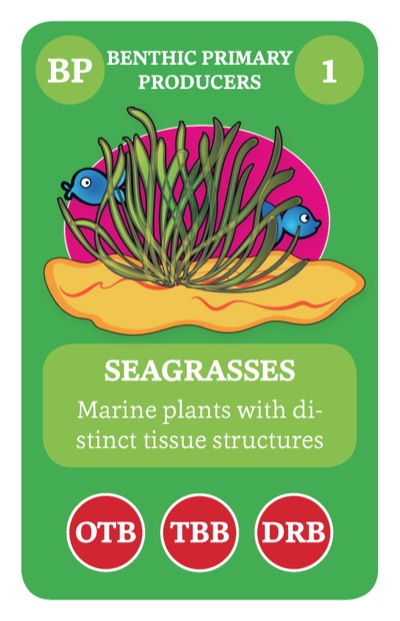 Seagrasses
7 copies
Benthic primary producers · Marine plants with distinct tissue structures
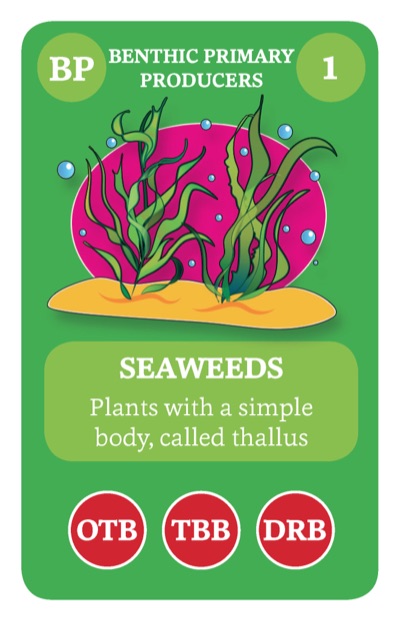 Seaweeds
7 copies
Benthic primary producers · Plants with a simple body, called thallus
2 Primary consumers
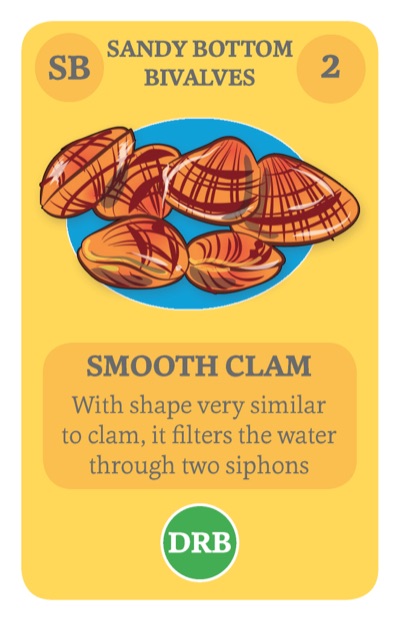 Smooth clam
6 copies
Sandy bottom bivalves · With shape very similar to clam, it filters the water through two siphons
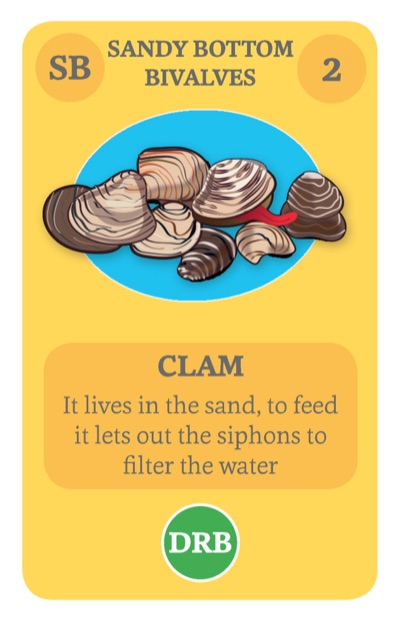 Clam
6 copies
Sandy bottom bivalves · It lives in the sand, to feed it lets out the siphons to filter the water
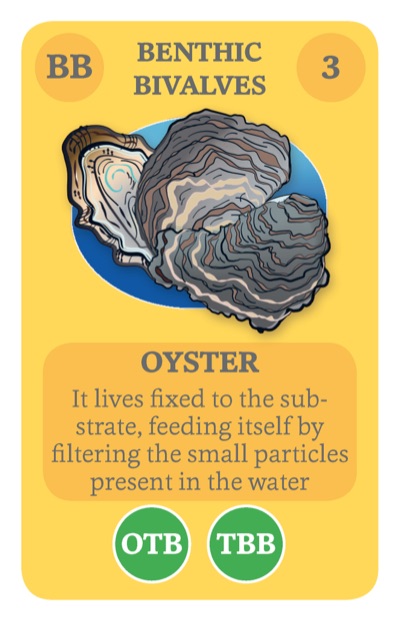 Oyster
5 copies
Benthic bivalves · It lives fixed to the substrate, feeding itself by filtering the small particles present in the water
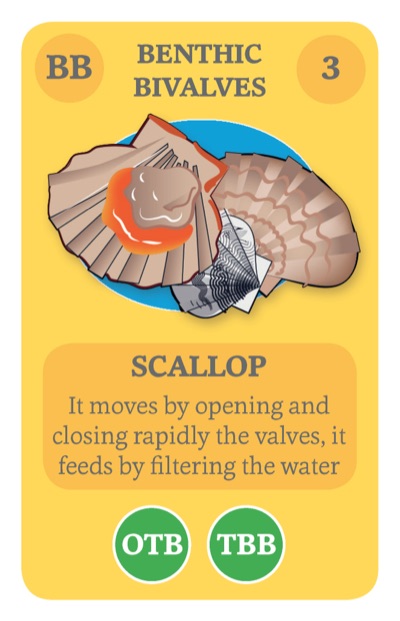 Scallop
5 copies
Benthic bivalves · It moves by opening and closing rapidly the valves, it feeds by filtering the water
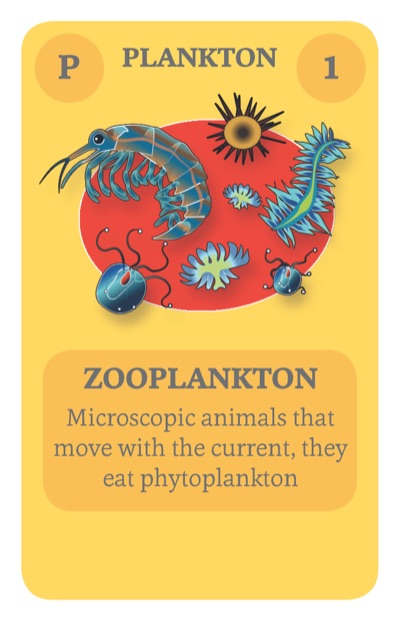 Zooplankton
4 copies
Plankton · Microscopic animals that move with the current, they eat phytoplankton
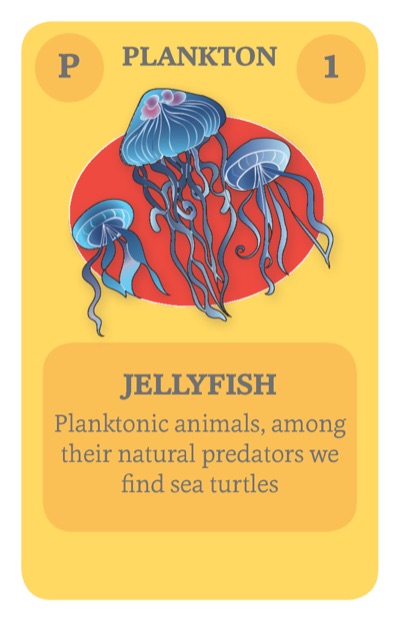 Jellyfish
4 copies
Plankton · Planktonic animals, among their natural predators we find sea turtles
3 Secondary consumers
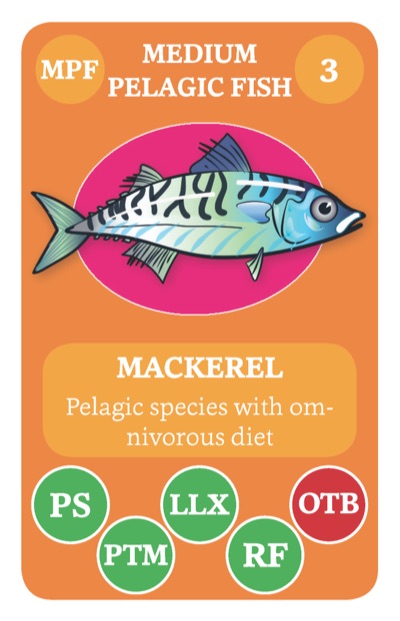 Mackerel
2 copies
Medium pelagic fish · Pelagic species with omnivorous diet
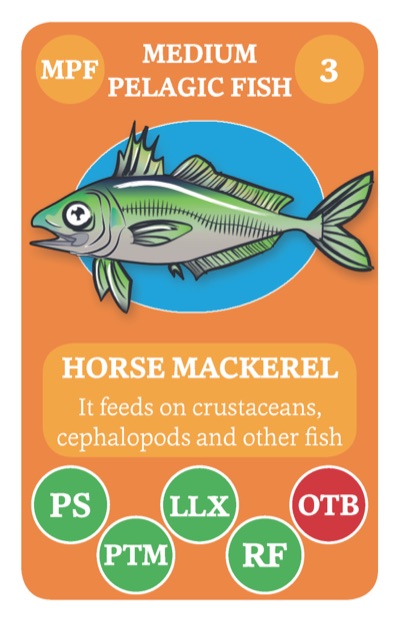 Morse mackerel
2 copies
Medium pelagic fish · It feeds on crustaceans, cephalopods and other fish
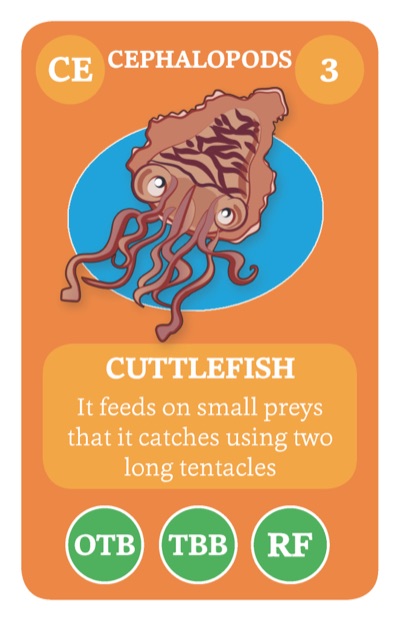 Cuttlefish
2 copies
Cephalopods · It feeds on small preys that it catches using two long tentacles
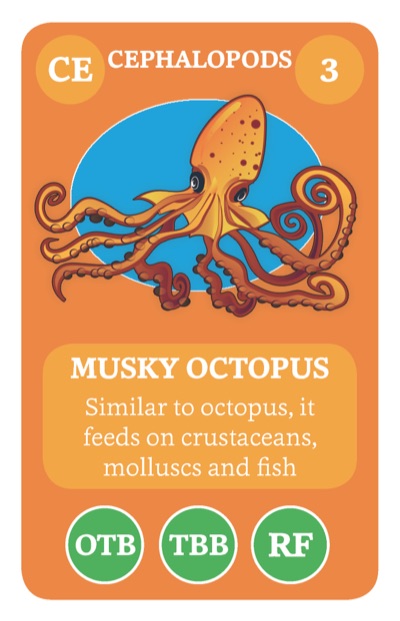 Musky octopus
Cephalopods · Similar to octopus, it feeds on crustaceans, molluscs and fish
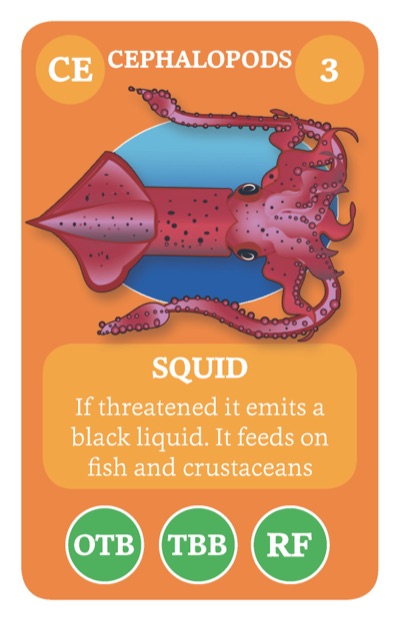 Squid
2 copies
Cephalopods · If threatened it emits a black liquid. It feeds on fish and crustaceans
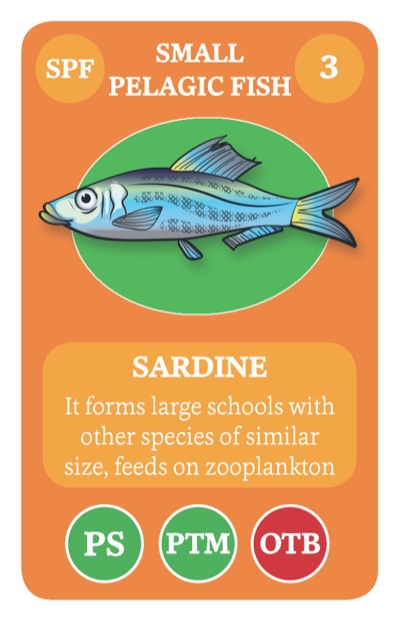 Sardine
2 copies
Small pelagic fish · It forms large schools with other species of similar size, feeds on zooplankton
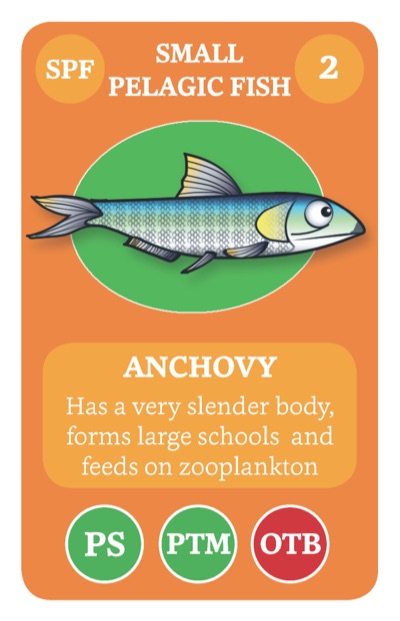 Anchovy
2 copies
Small pelagic fish · It forms large schools with other species of similar size, feeds on zooplankton
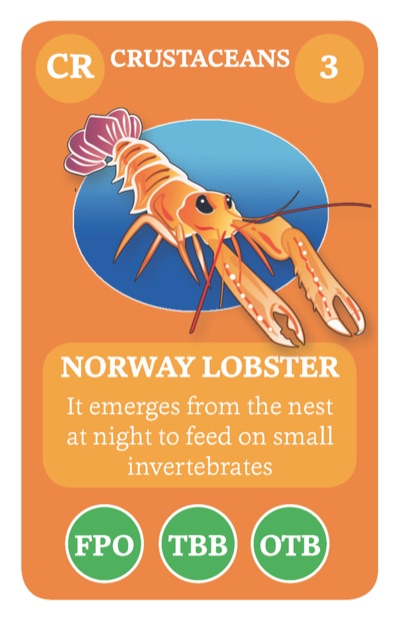 Norway lobster
2 copies
Crustaceans · It emerges from the nest at night to feed on small invertebrates
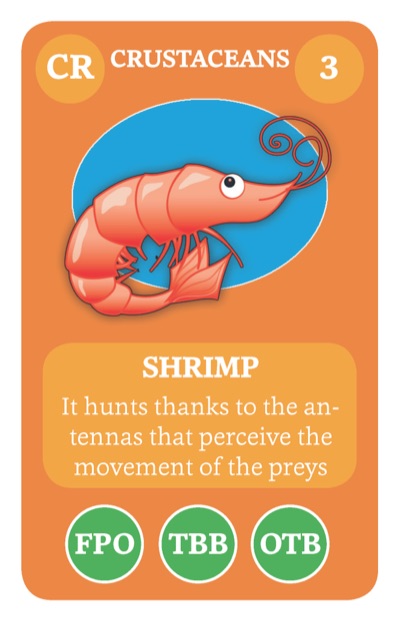 Shrimp
2 copies
Crustaceans · It hunts thanks to the antennas that perceive the movement of the preys
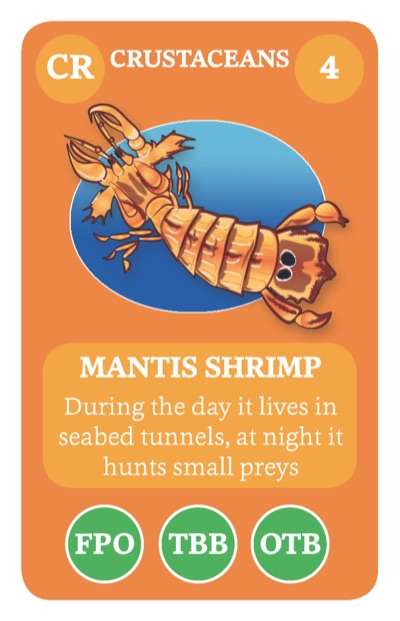 Mantis shrimp
2 copies
Crustaceans · During the day it lives in seabed tunnels, at night it hunts small prey
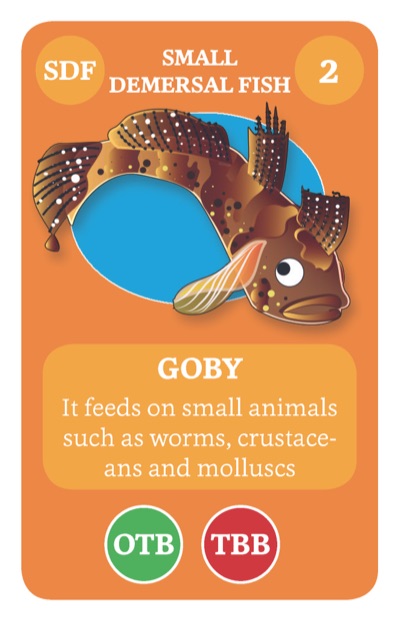 Goby
2 copies
Small demersal fish · It feeds on small animals such as worms, crustaceans and molluscs
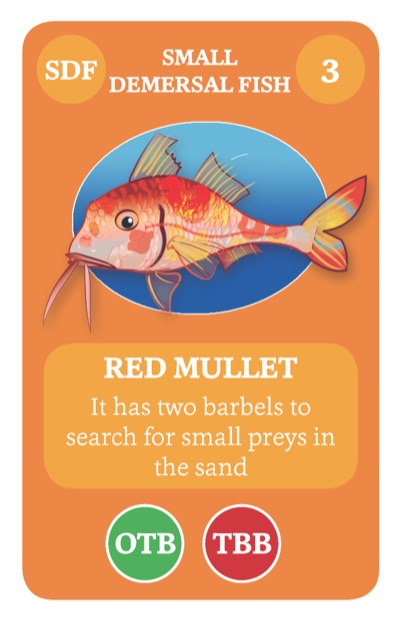 Red mullet
2 copies
Small demersal fish · It has two barbels to search for small preys in the sand
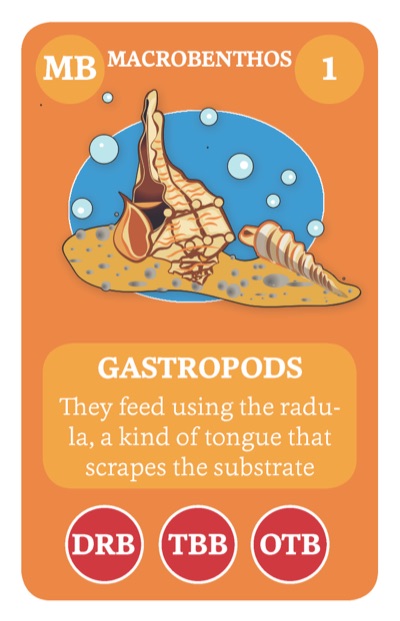 Gastropods
2 copies
Macrobenthos · They feed using the radula, a kind of tongue that scrapes the substrate
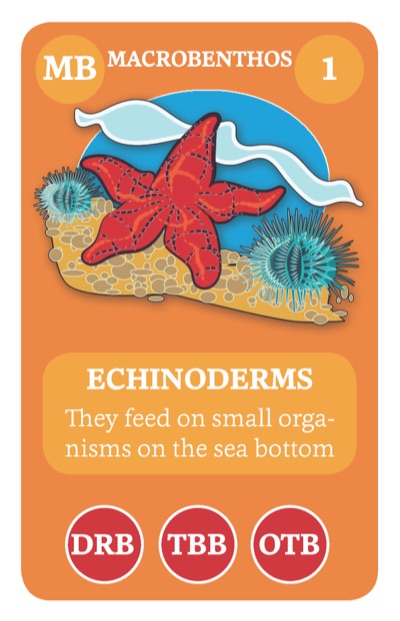 Echinoderms
Macrobenthos · They feed on small organisms on the sea bottom
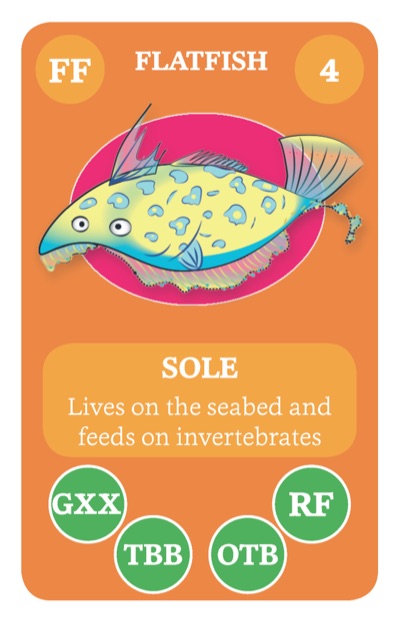 Sole
2 copies
Flatfish · Lives on the seabed and feeds on invertebrates
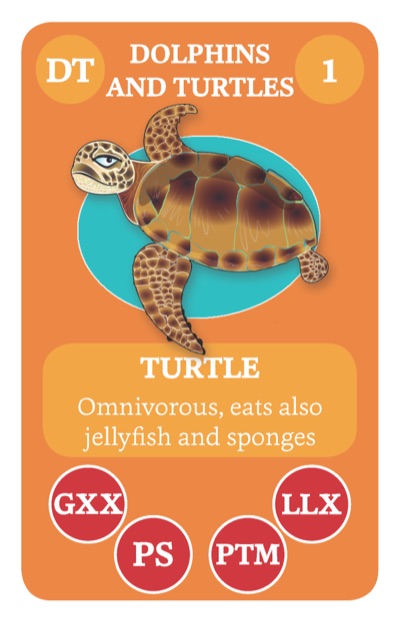 Turtle
2 copies
Dolphins and turtles · Omnivorous, eats also jellyfish and sponges
4 Apex predators
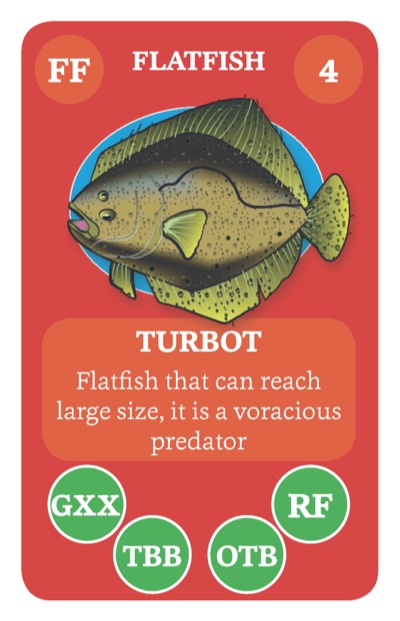 Turbot
2 copies
Flatfish · Flatfish that can reach large size, it is a voracious predator
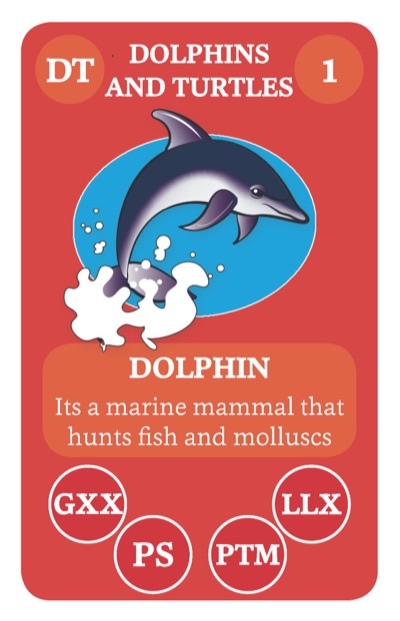 Dolphin
2 copies
Dolphins and turtles · Its a marine mammal that hunts fish and mollusks
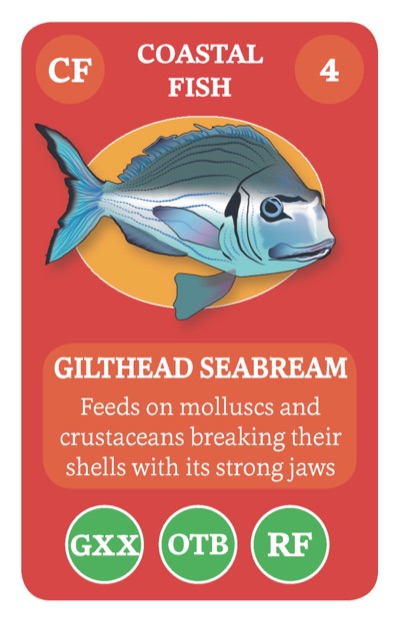 Gilthead seabream
2 copies
Coastal fish · Feeds on molluscs and crustaceans breaking their sheels with its strong jaws
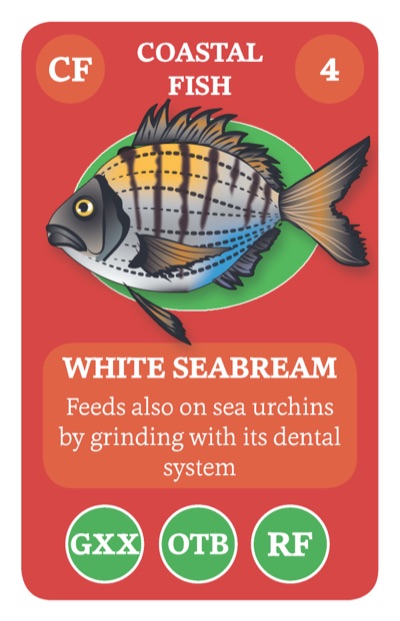 White seabream
2 copies
Coastal fish · Feeds also on sea urchins by grinding with its dental system
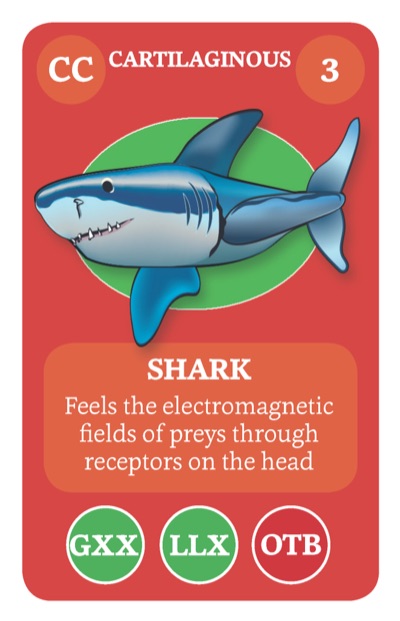 Shark
2 copies
Cartilaginous · Feels the electromagnetic fields of preys through receptors on the head
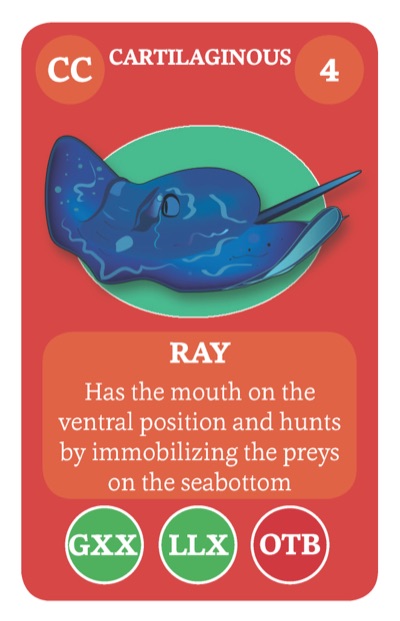 Ray
2 copies
Cartilaginous · Has the mouth on the ventral position and hunts by immobilizing the preys on the seabottom
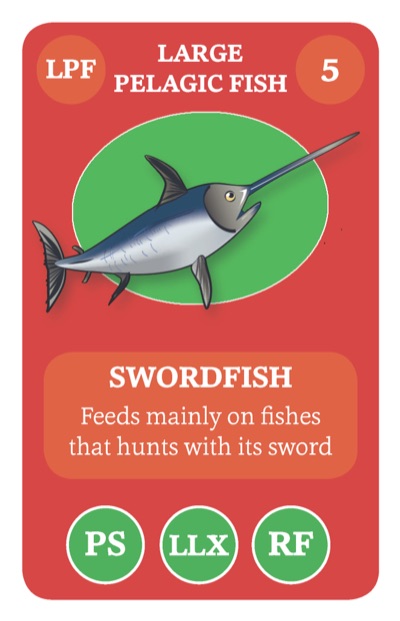 Swordfish
2 copies
Large pelagic fish · Feeds mainly on fishes that hunts with its sword
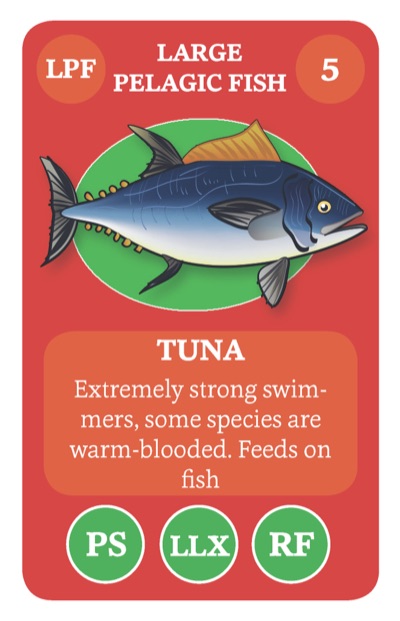 Tuna
2 copies
Large pelagic fish · Extremely strong swimmers, some species are warm-blooded. Feeds on fish
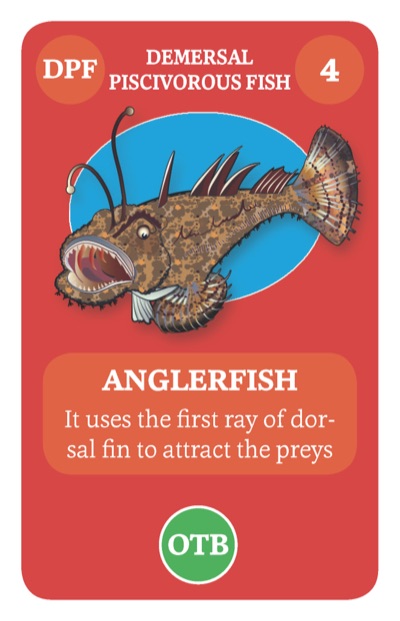 Anglerfish
2 copies
Demersal pescivorous fish · It uses the first ray of dorsal fin to attract the preys
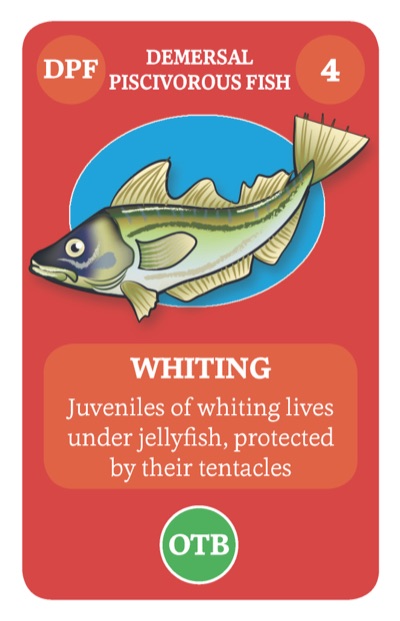 Whiting
Demersal pescivorous fish · Juveniles of whiting lives under jellyfish, protected by their tentacles
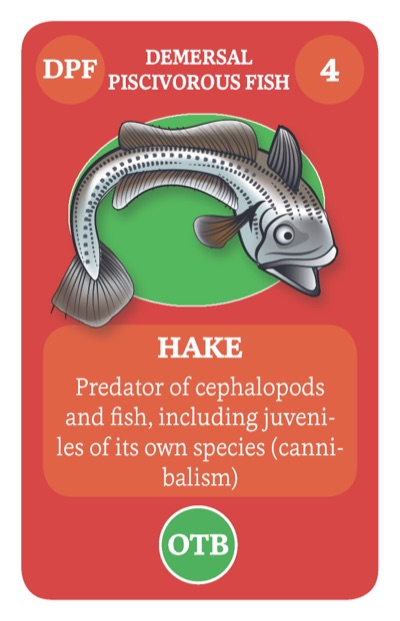 Hake
Demersal pescivorous fish · Predator of cephalopods and fish, including juveniles of its own species (cannibalism)
Malus
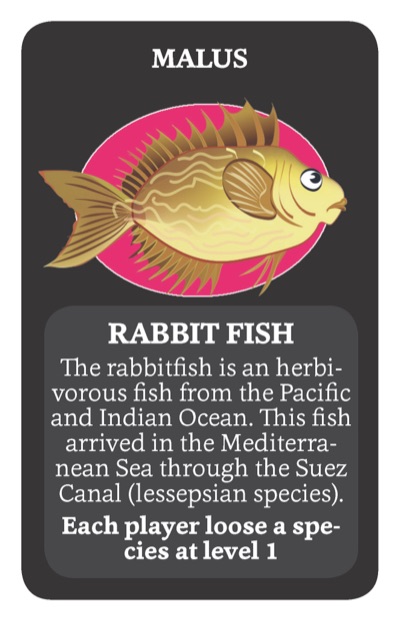 Rabbit fish
The rabbitfish is an herbivorous fish from the Pacific and Indian Ocean. This fish arrived in the Mediterranean Sea through the Suez Canal (lessepsian species)
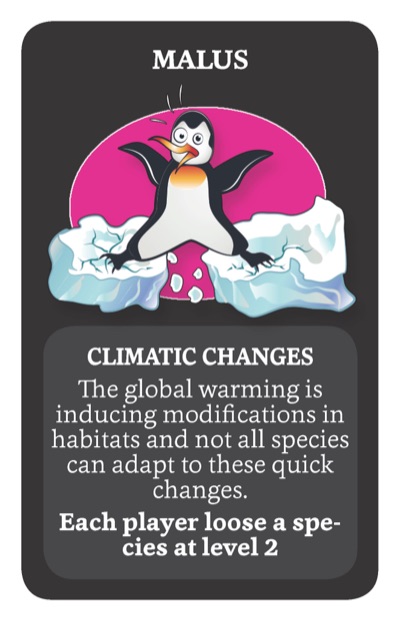 Climatic changes
The global warming is inducing modifications in habitats and not all species can adapt to these quick changes
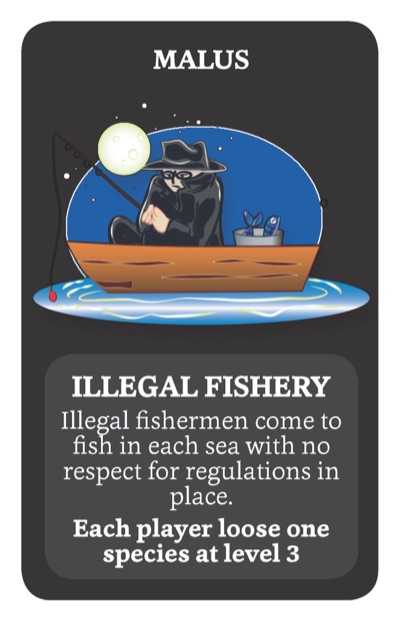 Illegal fishery
Illegal fishermen come to fish in each sea with no respect for regulations in place
Bonus
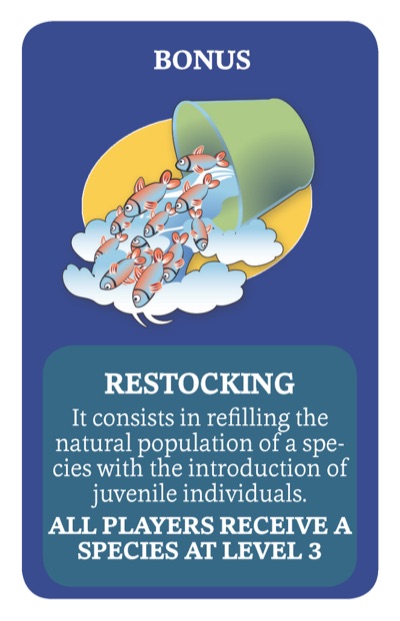 Restocking
This card can be placed in any position in your sea
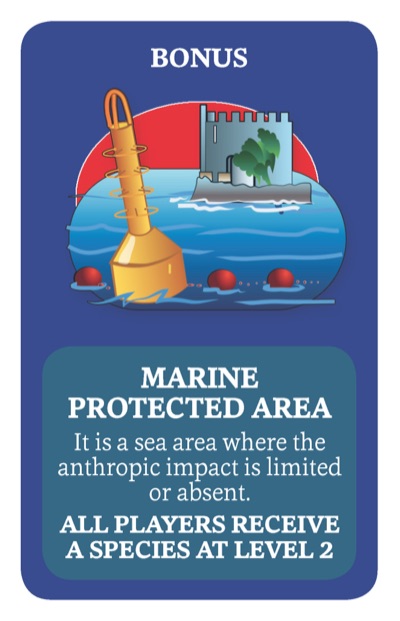 Marine protected area
Dophins and turtles are not affected by incidental fishing. This card needs to be placed over the DT card that you intend to protect
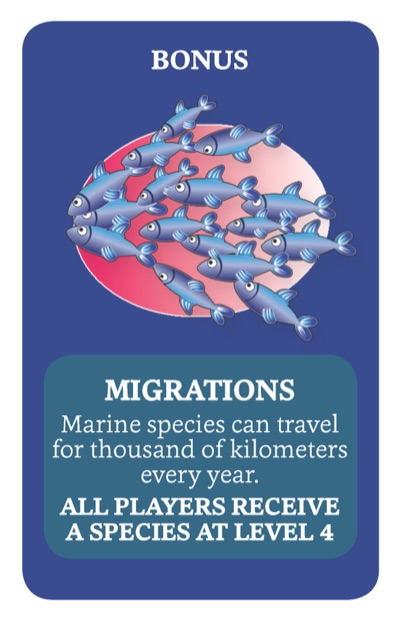 Migrations
If your sea allows it, you can move a species of level 4 from another player's sea to yours. After using the card it will be discarded.
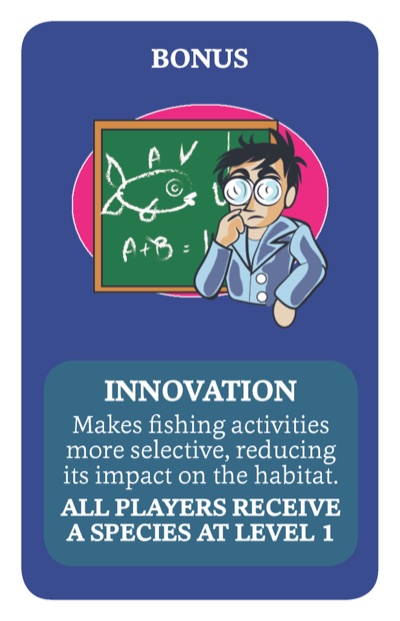 Innovation
Makes fishing activities more selective. Use this card together with a fishing technique in order to avoid its negative effects (discards). Then the card will be discarded.
The fishing systems
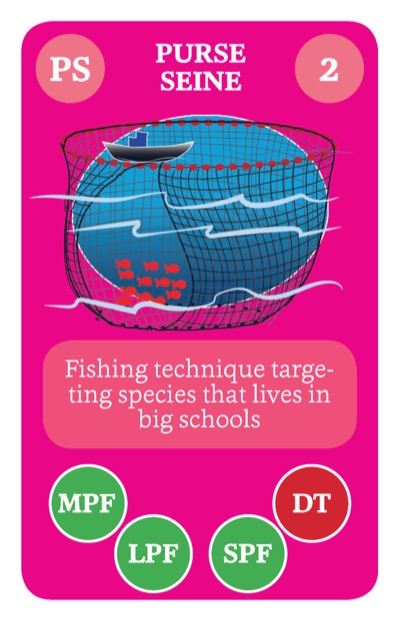 Purse seine
Fishing technique targeting species that lives in big schools
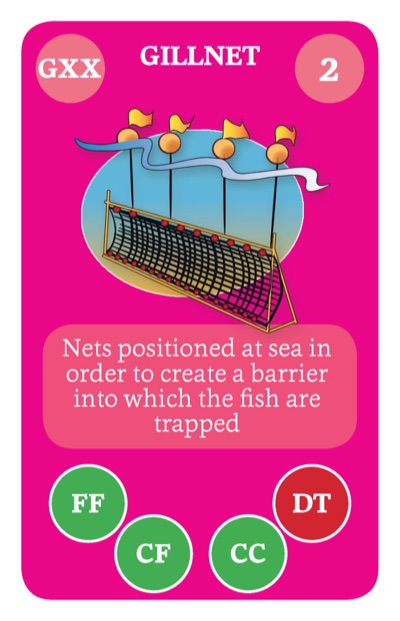 Gillnet
Nets positioned at sea in order to create a barrier into which the fish are trapped
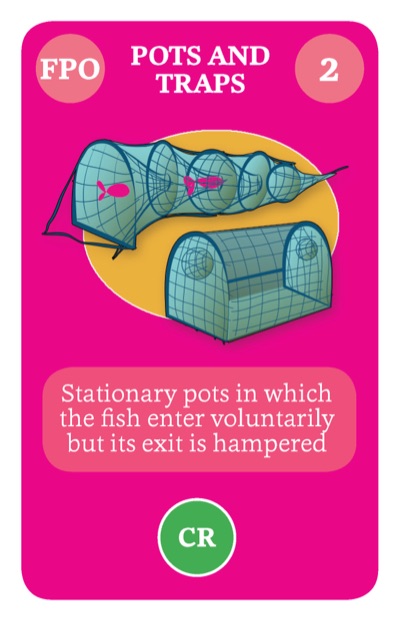 Pots and traps
Stationary pots in which the fish enter voluntarily and will be hampered from escaping.
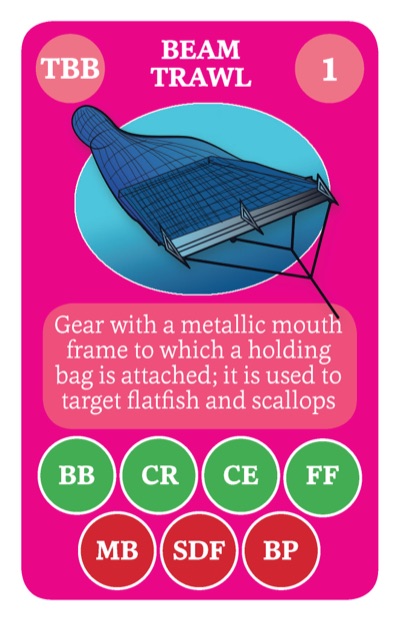 Beam trawl
Gears consisting of a mouth frame to which a holding bag constructed of metal rings or meshes is attached used to target flatfish and scallops
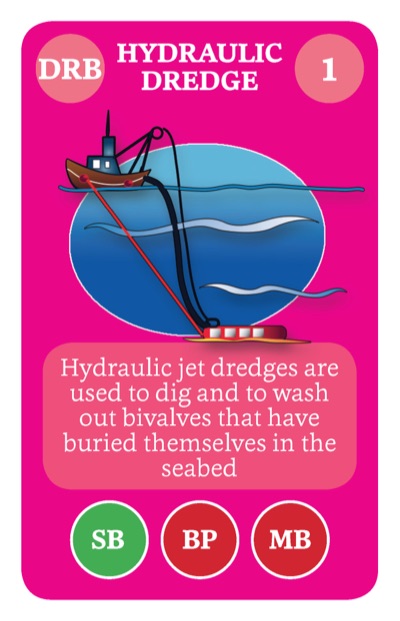 Hydraulic dredge
Hydraulic jet dredges are used to dig and to wash out bivalves that have buried themselves in the seabed
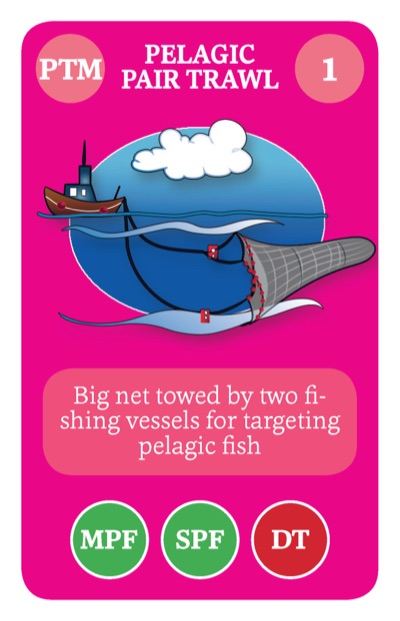 Pelagic pair trawl
Big net towed by two fishing vessels for targeting pelagic fish
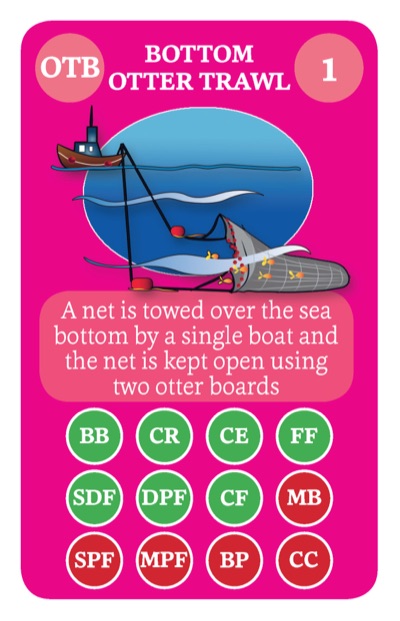 Bottom otter trawl
A net is towed over the sea bottom by a single boat and the net is kept open using two otter boards
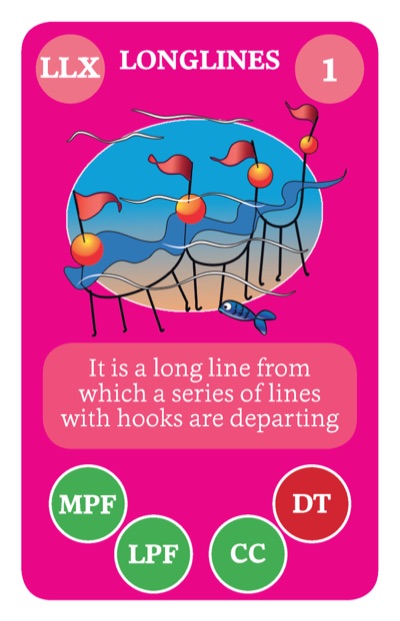 Longlines
It is a long line from which a series of lines with hooks are departing
Trophies and roles
Each trophy is worth different points depending on the role chosen at the start of the game.
| Fisher | Researcher | Conservationist | Neutral | |
|---|---|---|---|---|
| Big predatorsYou caught both big pelagic fish! They are the most valuable commercial fish! | 6 | 0 | 0 | 4 |
| Sea horseYour sea is rich in phanerogams! These are the ideal habitat of the sea horse that likes to cling to them with its tail! | 0 | 0 | 8 | 3 |
| BiodiversityYour sea contains as many as eighteen different species. Biodiversity is very important! | 0 | 10 | 12 | 5 |
| Selective fishingYou have used all the fishing techniques considered most sustainable for reducing discarded fish! | 8 | 0 | 0 | 4 |
| Diversified fishingYou fished from three trophic levels. It's important to maintain ecological balance! | 10 | 6 | 0 | 4 |
| Protected speciesIn your sea there are both dolphins and turtles, two very important protected species! | 0 | 4 | 8 | 4 |
| Happy seaYour sea is populated by many organisms, a wealth for conservation! | 0 | 0 | 12 | 3 |
| Sustainable fishingYou fished without causing secondary effects, well done! | 4 | 0 | 0 | 3 |
| Resilient seaThe malus did not cause excessive damage to your sea, a sign that it is in great balance! | 0 | 6 | 6 | 3 |